"Shining the Light of Reason on the Lone Star State"

| HOME | ABOUT | OTHER PUBLICATIONS | NEWS & VIEWS | HALL OF FAME | GAZETTEER | CONTACT |
"Shining the Light of Reason on the Lone Star State" | |||||||
| |||||||
|
|
TEXAS FREETHOUGHT HALL OF FAME The Texas Freethought Hall of Fame is a pantheon of prominent Texas Freethinkers of the past. They are divided into two categories: ACTIVISTS and NOTABLES. If you would like to nominate someone for this honor, please send your nomination, explaining why you think some individual (or group) is worthy of inclusion, to secularscholar@outlook.com. Thanks!
|

 Link to "Find-a-Grave" Memorial |
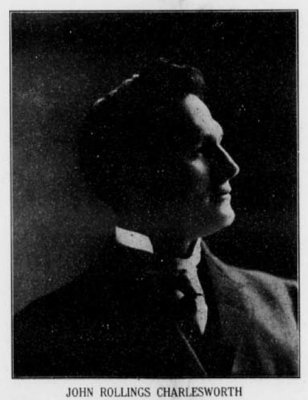
John R. CHARLESWORTH ACTIVIST John Rollings Charlesworth was born in the parish of Cripplegate, London, England, on April 27, 1864, but grew up in Nottingham, where he learned the bricklayers trade and at an early age, joined the National Secular Society, founded by Charles Bradlaugh, the first openly atheist member of Parliament. Following the death of Charlesworth's father in 1880, he and his mother returned to London. On June 1, 1884, in Nottinghamshire, he married Mary Ann Burton, with whom he had a daughter, Helen Hypatia (born in England), and two sons--Alfred (born in England), and Charles B. (born in New York). In 1886, Charlesworth immigrated to America, where in 1890, he "commenced lecturing upon the freethought platform" (Blue Grass Blade, Lexington, Kentucky, May 24, 1908, p.2). In 1892, Charlesworth joined with Samuel Putnam to form the Freethought Federation of America in Chicago. In 1893, he was elected Secretary. Sometime before December 1894, Charlesworth and his first wife were divorced. Afterward, he married a fellow freethinker, Miss Isla B. Martin, of Wichita, Kansas, with whom he had five more children. In England, Charlesworth had studied natural science. In America he continued his studies but also read law. In 1895, while living in Dallas, Texas, he was admitted to the bar. From 1894 to 1900, along with Ormond Paget and David MacKay he became the public voice of the Dallas Freethinkers society. (See Legacies: A History Journal for Dallas and North Central Texas, Fall 2012, p. 21.) "In 1898, he was admitted to the Supreme Court of Texas, later to the United States District Court, and...to the Department of the Interior, at Washington, D.C." (Blue Grass Blade, Lexington, Kentucky, May 24, 1908, p.2). In 1900, Charlesworth went to Lexington, Kentucky to help in the defense of Charles Chilton Moore, the editor of The Blue Grass Blade, a freethought newspaper, who had been indicted on federal charges of sending obscene matter through the mail. Liking Kentucky, he decided to stay and pursue a career in journalism. In 1908. after Moore died, Charlesworth became the new editor of The Blue Grass Blade. In 1910, Charlesworth and his wife moved to Delta County, Colorado, where he became district attorney. In 1911 and 1912, he served as deputy district attorney. In 1912, he was commissioned a captain of the Colorado National Guard. In 1916, he served on the Mexican border and in 1917 went to France, where he served until near the end of the First World War. After the war, he was promoted to the rank of Colonel. In 1931, after the death of his first wife, Charleworth married Mrs. Cleaola Clark of Hotchkiss, Colorado. He was a member of the Delta Elks Lodge, Knights of Pythias, I.O.O.F, and the American Legion. He died on October 5, 1931 and was buried in the city cemetery at Delta, Colorado. |
 Link to "Find-a-Grave" Memorial |
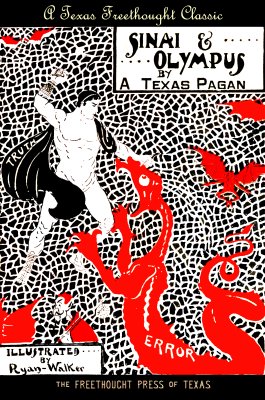
Charles Littleton Edwards ACTIVIST Born in Monroe County, Georgia on August 30, 1844, Edwards was first child and eldest son of a farmer named George W. Edwards and his wife, Eliza (née McMullen). After the Civil War began, Edwards enlisted in the Confederate Army, serving until the end of the conflict as a private in Co. H, 32nd Georgia Infantry. Sometime after the war, Edwards left Georgia and settled in Ennis, Ellis County, Texas, where he worked for a weekly newspaper called The Review. He also joined a local debating club that began meeting in 1874. It has been said that the group's "public debates were great occasions to the early settlers of Ennis, as the most weighty questions in politics and religion were fully discussed by its members, taking sides according to their convictions of right." According to the same source, it "was in this debating society that Mr. Charles L. Edwards…became convinced that [he] had missed his calling, and that the law was [his] proper field." On June 19, 1877, The Dallas Daily Herald reported that Edwards had "retired from the Review, at Ennis, to practice law." Like a lot of lawyers in Texas at that time, it's likely that Edwards did not attend law school, but instead was tutored by a practicing attorney until he was sufficiently knowledgeable to pass the state bar exam. On April 14, 1881, at Ennis, Edwards married Mary Catherine "Mollie" Allen. They had one child, a son named George Frank Edwards, born 1883. Around 1890, Charles L. Edwards moved his family to Dallas, where he opened a successful law practice law in partnership with James R. Blewett at 150 Main Street. There is some evidence that he may have lived in Dallas for a brief period in the early 1870s and that at that time he met Dr. David MacKay, the longtime president of the Dallas Freethinkers Society, which was first organized and began meeting in 1885. Although Edwards, a native-born Southerner, was almost certainly raised a Christian, by the 1890s he had abandoned the superstitions of his youth, and found the light of reason. After moving to Dallas, he not only became a member of the local Free Thinkers society, but also a frequent lecturer on topics as varied as "Our Animal Kindred," "The Credentials of Moses," "Agnostics and Agnosticism," and "The Fossils as Witnesses." On two occasions in 1896, he defended Darwin's Theory of Evolution. In 1899, Edwards' book, Sinai and Olympus, was published in 1899 by The Truth Seeker Company of New York City, who identified him only as a "Texas Pagan." He also contributed articles to J. D. Shaw's The Independent Pulpit. Sometime between 1910 and 1913, Edwards gave up his law practice and began growing pecan trees at a nursey he operated in the Oak Cliff section of Dallas. On September 27, 1928, Charles L. Edwards died in Dallas. He was buried in Oak Cliff Cemetery. |
|
Link to "Find-a-Grave" Memorial |
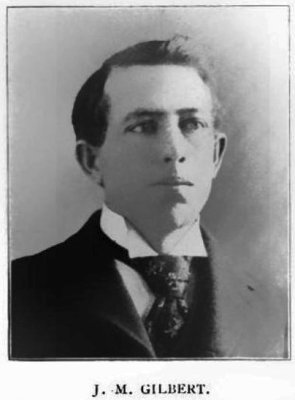
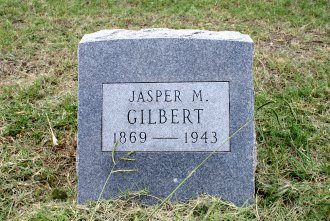
Jasper Monroe GILBERT, ACTIVIST, was born January 1870 in Fannin County, Texas, the son of Jasper Gilbert, Sr. and Rebecca Lindsey Gilbert. His paternal grandfather was Capt. Mabel Gilbert, an early day pioneer in both Dallas and Fannin counties. He was raised as a conventional Christian in Randolph, Fannin County, Texas by his mother and stepfather Woodruff P. Hall. Around 1880-1890, Gilbert traveled to California. While residing in Los Angeles he began attending Unitarian church services and also took some interest in spiritualism. A few years after returning to Randolph, he began to have doubts about the authenticity of the Bible and religion in general. After reading Volney's Ruins, John William Draper's History of the Conflict Between Religion and Science, and works by Ingersoll, Darwin, Huxley and Haeckel, he not only became an atheist but also an outspoken opponent of organized religion. In politics he embraced Populism before converting to Socialism, and then finally Anarchism. In 1897 he wrote the first of several letters and articles that were published in D. M. Bennett's The Truth Seeker. During the early 1900s his work also appeared in Free Thought Magazine and other "infidel" publications. In 1898 Gilbert enrolled at the American Medical College in St. Louis, Missouri. In 1902 he was graduated with degree in "eclectic" medicine. After living briefly in Homer, Indian Territory (present-day Oklahoma), he returned to Randolph, where it appears he remained for the rest of his life. Unable to make a living as a doctor, he turned to farming. During the second decade of the twentieth century many of the "infidel" publications Gilbert wrote for began to close down. With no outlets for his work, his writing seems to have ceased. Between 1919 and 1921 Gilbert was treated for a cancerous growth on his face, doubtless the result of exposure to intense sunlight while working in the fields. For a while he thought he was cured but after the cancer returned, he grew despondent. On May 19, 1943, he committed suicide in Dallas. He is buried at the Lindsey-Randolph Cemetery, Randolph, Fannin County, Texas. |
|
Link to "Find-a-Grave" Memorial |
Thomas Austin HUTCHINS "The Sage of Ysleta" ACTIVIST Thomas Austin Hutchins was born on June 26, 1848 at Duxbury, Plymouth County, Massachusetts, but grew up in Boston, where he was educated. He was a lineal descendant of celebrated Mayflower passengers John Alden and Priscilla Mullins as well as a distant cousin of President Franklin D. Roosevelt. In 1869, Hutchins founded the East Boston Advocate and ran it until 1874, when he sold his interest in the paper. "He also printed the first copies of Cyrus Curtis's Saturday Evening Post. He was financial advisor to Cuban and South American financial institutions and a pioneer in the moving picture industry, introducing film projectors to France." He moved to Fort Davis, Texas in 1904 and to Clint, near El Paso, in 1917. During the final ten years of his life, he resided in Yselta, Texas--10 miles north of Clint. On July 6, 1871, at Boston, Hutchins married Clara Pond, who he later divorced. They had three sons and a daughter. in 1901, his former wife remarried. Hutchins did not. During the 1920s, when he was in his seventies, Hutchins wrote several articles and letters to the editor, which were published in El Paso newspapers. Most either defended evolution or were critical of religion. In 1931, at the age of eighty-two, he helped found the Southwestern Rationalist Association, a group of agnositics and atheists who held regular meetings. After Hutchins died, a friend said that he "was known for his clarity of thought his serenity is friendliness when critics in the press and pulpit denounced him as un-American he merely smiled." He died on February 27th 1935 at Providence Hospital in El Paso Texas after being struck by an automobile while crossing the street. Following a non-religious funeral service, he was buried at Evergreen Cemetery, in El Paso. (See El Paso Herald, February 27, 1935.) |
|
|
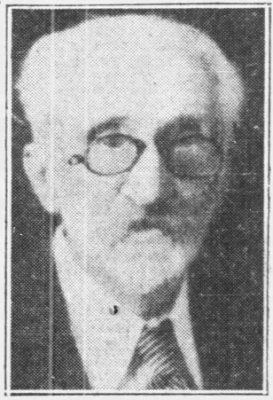
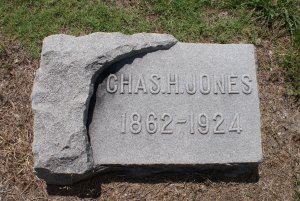
Charles H. JONES, ACTIVIST, was born in Cass County, Missouri on October 20, 1861. His father was Lycurgus Jones, a Kentucky-born farmer. His mother, Martha A. (Younger) Jones, was born in Missouri. Three maternal uncles, Cole, Jim and Bob Younger, were outlaws who robbed banks and trains in league with equally notorious outlaw brothers Frank and Jesse James. Jones had one sister and three brothers, two of which may have been named in honor of his outlaw uncles. In 1881, the Lycurgus Jones family moved to Denison, Texas, where father and sons, unlike their notorious relatives in Missouri, were respectable citizens who operated a furniture business on Main Street. Following the death of his father, and after brothers Coleman and Robert moved to Indian Territory, the Denison store began operating under Charles' name only. On July 30, 1902, Charles H. Jones married Minnie M. Marsh, a teacher and principal in the Denison schools and an instructor at North Texas Normal College in Denton. She was also an occasional writer and orator. In 1910 Jones left the furniture business to sell real estate and make loans. At some point in his life, Jones became an atheist. Between 1916 and 1918, he wrote twenty-four short articles criticizing religion, which were printed as paid advertisements in two local newspapers. Jones also kept a close watch on news of a religious nature and attended church services from time-to-time, apparently to listen to sermons that he would later rebut in print. Jones was a well-read materialist who based his opinions on the fact that none of the claims made by Christianity could be proven. He was also apparently very familiar with the Scriptures. In his articles he often pointed out Bible verses that were contradictory or seemed to make no sense. Jones died of pneumonia on March 14, 1924 while vacation with his wife and daughter in Dallas He was buried at Denison's Fairview Cemetery. From 1960 to the present time, the Mr. and Mrs. Chas. H. Jones Trust Fund, a legacy from the Jones estate, has provided continued financial support to the Denison Public Library. |
|
Link to "Find-a-Grave" Memorial |
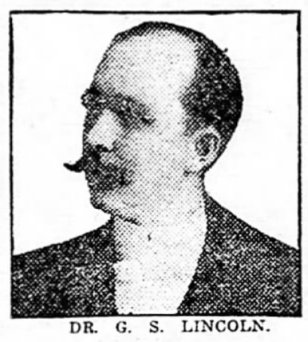
Geno Scott LINCOLN ACTIVIST From 1894 to 1896, Dr. Geno Scott Lincoln, a native of Rushville, New York (born May 1, 1866), served as president of the Dallas Freethinkers Society. Lincoln, who appears to have been the driving force behind the group at this time, was only twenty-eight years old when he was first elected to office. By chance, the young physician was listed in the 1894 Dallas city directory immediately preceding Dr. David Mackay, who was the oldest of the group's three vice-presidents, elected on May 23, 1894, along with a young Hungarian immigrant named Alexander Horr and Lincoln's wife, Hattie. By 1920, Lincoln was living in San Antonio, where he died on June 30, 1929. He was buried at the Knights of Pythias Cemetery. |
|
Link to "Find-a-Grave" Memorial |
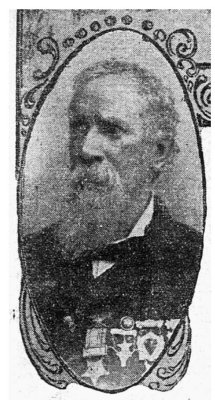
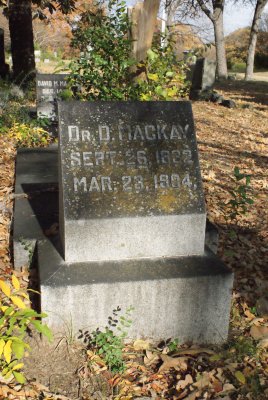
David MACKAY ACTIVIST Dr. David Mackay, the glue that kept the Dallas Freethinkers society together, was born in Scotland in 1832. He was graduated from the University of Glasgow in 1855. After serving as an assistant surgeon in the Royal Navy during the Crimean War, he immigrated to the United States, where he completed four years of medical training. During the Civil War, Mackay served as a field surgeon in the Union Army, attending the wounded "in many noted battles of the war." At "the close of the national contest," he went to live in New Orleans, where he was Surgeon of the Marine Hospital before being appointed City Physician -- a post he held for three years. During Reconstruction, Mackay and his wife Maggie removed to Dallas. In 1871, when Texas got its first free public schools under the administration of Governor Edmund J. Davis, the bearded Scotsman was appointed supervisor of the education district that included Dallas. During this period, Mackay later recalled, "The people of Texas were not in a frame of mind to embrace the free school system along with a great many other Northern importations." Texans were likewise "slow to adjust themselves to the novel idea of a negro being on the same plane as a white person, insomuch as both imbibing learning from teachers of uniform ability and intelligence." Consequently, wrote one observer, "Dr. Mackay and the other supervisors of the free public school districts of the state did not find themselves on a bed of roses when they took their new position and began the work of educating whites and negroes alike." Nevertheless, Mackay persevered and in 1874, Dallas' first free public schools were opened, although they were racially segregated and would remain so for nearly one hundred years. From 1880, when the Dallas Freethinkers society was formed, until his death in 1904, MacKay was active in the affairs of the organization, serving in various capacities, including Secretary and sometimes President. He was also a frequent lecturer. His favorite topic was "Brainism." In September 1900, following the departure of Ormond Paget and John R. Charlesworth, Dr. Mackay, now nearly seventy, once again ascended to the presidency of the association. In August 1901 he presided over the annual Robert G. Ingersoll memorial meeting, where he made a lengthy speech extolling the virtues of the late departed "Prince of Agnostics." Exactly one year later the Dallas Freethinkers held what was in all likelihood their very last meeting. By the time that Dr. Mackay passed away on March 23, 1904, the Freethinkers of Dallas, as an organization, had almost certainly disbanded. A report of Mackay's death, in the Dallas Morning News, made no mention of his "infidelity," but in his will, he asked that his body be cremated, that his funeral be inexpensive, "and that no religious service or ceremony of any kind or character be had thereat or at any time connected thereat and that not even the religious portion of the funeral ceremony of the Grand Army of the Republic shall be permitted." Mackay's funeral was held on the afternoon of Friday, March 25, at his residence, "at the corner of Austin and Young streets, under the auspices of Richard J. Oglesby Post, Grand Army of the Republic." "In accordance with the request of the Doctor," it was reported, "the exercises will be of a very simple character." Afterward, he was buried at Oakland Cemetery in South Dallas. |
|
Link to "Find-a-Grave" Memorial |
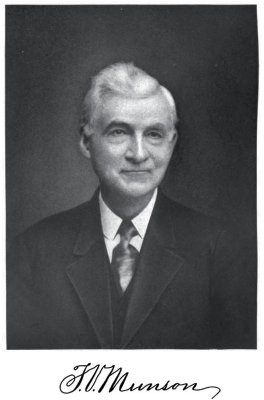
Thomas Volney MUNSON, ACTIVIST, was born at Fulton County, Illinois on September 26, 1843. His parents were William and Maria (nee Linley) Munson. He had two brothers and three sisters. Munson's parents were members of the Disciples of Christ, who raised all their children in that denomination. In 1861 Munson enrolled in business school in Chicago, and then taught school back home for a year before enrolling at the Kentucky Agricultural and Mechanical College at Lexington, where he first had doubts about the religious beliefs he had been taught as a child. After reading Darwin's On the Origin of Species (1859), and also The Variation of Animals and Plants under Domestication (1868), he gave up the Christian faith entirely. On June 21, 1870, less than two weeks being graduated with a Bachelor's degree, Munson was married to Ellen Scott Bell. In 1873 Munson and his wife bought property near Lincoln, Nebraska. In 1876, the couple moved to Texas, where Munson's brothers had helped to found Denison four years earlier. From 1876 to 1887 the Munson family resided on a small farm where the budding botanist started the nursery business that sustained him and his family throughout his long life. He also won the first of many awards, and socialized with his fellow "infidels," a minority in a town filled with churches. Among those with similar views were brothers Theo and Ben, and Sunday Gazetteer publisher B. C. Murray. In 1880, Munson was one of the founders of the Denison Liberal League. In 1884, a year after earning a Master's degree from his alma mater in Kentucky, he wrote the first of several freethought articles that were published in J. D. Shaw's Independent Pulpit. In 1887 Munson and his family moved into the house he named "Vinita." In 1889 Munson was awarded a gold medal by the French government for saving the French wine industry from certain ruin by sending pest-resistant grafts from his Texas vines. The following year, after founding the Denison Philosophical Society, he was elected treasurer of the Texas State Liberal Association, a position he held for at least three terms. In 1906, B. C. Murray published Munson's small anti-religious tract, The New Revelation, in which he openly wrote of his atheism. On January 21, 1913, Munson died. He was buried at Denison's Fairview Cemetery, following a completely non-religious funeral. |
|
Link to "Find-a-Grave" Memorial |
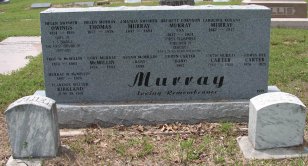
Bredette Corydon MURRAY, ACTIVIST (From a presentation by Dulce Murray to the Red River Historical Society at Sherman, Texas, December 11, 1926) Bredette Corydon Murray was born in Allegan, Michigan, January 14, 1837—the year his native state was admitted to the Union. B. C. was the only child of Edwin A. and Caroline Roxana West Murray. His father was a joiner by trade, and much of the inside finishing work of the early homes in Allegan was his handiwork. The boy's mother was a lineal descendant of Miles Standish. B. C. entered the printing office of Elisha Bassett, a cousin of his mother, at the age of 13 years. He graduated from the Allegan Seminary and a business college in Kalamazoo. After graduation he held a clerical position in the Recorder's Office in Kalamazoo. He was fond of travel and adventure; when a lad of about 17, he volunteered to carry the mail, horseback, from Allegan to Lansing, the state capital, to relieve the regular mail carrier. It was a lonesome ride through miles of country with no sign of human habitation. One trip was enough. At the age of 20 years, B. C. left Michigan and went by way of New Orleans to San Antonio, Texas. In New Orleans he did reportorial work for some time. In San Antonio, he became associated with Dr. L. S. Owings in the mercantile business. Later, when Dr. Owings was appointed governor of the New Mexico Territory, Murray purchased a printing press plant and freighted it by wagon train from San Antonio to Mesilla, New Mexico. He established the Mesilla Times about 1859. At the outbreak of the Civil War, when it became apparent that the Mission would fall into the hands of Federal troops, he buried his plant for safe keeping; after the evacuation of the troops he resurrected the plant and resumed business at the old stand. The adobe office of the Mesilla Times was in a state of perfect preservation as late as the fall of 1919. Soon after the beginning of hostilities between the North and South, Murray assisted in mobilizing a regiment of cavalry in the vicinity of Mesilla and served throughout the duration of the war on the side of the Confederacy. After the surrender, this company preserved order in San Antonio and vicinity until the Federal troops arrived to take charge. Once during the war, B. C. was compelled to swim the Rio Grande. Another time, he and two or three companions became separated from their command. They had been hiding in the brush for several days and were without food, when they saw a commissary train approaching. Not knowing whether the train contained friends or foes, they resolved to reach it and ask for food. As the famished men staggered into the road, the Negro driver jumped from his seat and ran, believing them to be ghosts. They had been given up for dead. The train proved to be their own commissary. After the close of the war, B. C. remained in San Antonio and became identified with the San Antonio Express. In that city he was united in marriage, on October 7, 1866, with Miss Amanda Swischer. She was a grand-niece of Milton and Monroe Swischer, pioneer Texans; a distant cousin of General Sam Houston; and a sister-in-law of his old friend, Gov. L. S. Owings. Dr. Owings would become the first mayor of Denison in 1873–75. Five children were born the Murrays, four daughters and one son. One daughter died in 1903. In 1868, Murray went to Topeka, Kansas, and for a time was employed as compositor on the Topeka Commonwealth. Not liking that cold climate, he again returned to Texas, taking up residence in Austin where he, Charles Deffenbach, and one other gentleman in 1870 bought the plant of a defunct Republican paper, changing its politics and giving it a new name, The Democratic Statesman. This was during the administration of Gov. E. J. Davis, referred to by the Texans of those days as the "carpetbag executive." Against Davis, Murray wielded his pen unceasingly, with the result that that gentleman was retired to civil life by an overwhelming majority. In the fall of 1872, having disposed of his interests in Austin, B. C. came with his family to Denison, known as "the Gate City" and more often referred to as "the Infant Wonder." Here Murray established the Denison Daily News, in a small room built of unseasoned upright boards in the 300 block of Skiddy Street, now known as Chestnut Street. About the only equipment he had was a few fonts of type and a Washington hand press. Initially the family was domiciled in a tent at the corner of South Austin Avenue and West Morgan Street. For over thirty years, this was the home place, the dwelling itself being added to as the family increased. The house was destroyed by fire of incendiary origin after a hard-fought battle of a political nature in the spring of 1907. Murray then moved to 1031 West Main Street. On December 27, 1872, the first issue of the Weekly News was printed, and this was followed on February 22, 1873, by the publication of the Daily News. For eight years, the Daily News never failed to greet its patrons in time for breakfast. Murray never left the plant until the last paper was off the press, ready for the carrier. I say "carrier" advisedly, as one was sufficient for the circulation of that early paper; the editor and the printer's devil (alias the carrier) were the whole force in those prehistoric times. In 1876, the two-story brick building at 112 West Main Street was erected, and the plant of the Daily News was moved to the second story and enlarged, as to both equipment and staff. A city editor was added, the devil was promoted to pressman, and a new devil was installed. In 1881, Murray sold the circulation of the News to the proprietors of the Herald and devoted his time to job printing, which included posters and show printing. It was about this time that he established the Murray Power Printing Plant, which became one of the leading printing houses of the Southwest. Specializing in theatrical and billboard printing, the firm received and filled orders from as far awat as St. Louis and Kansas City; Houston, Galveston, and San Antonio. In the spring of 1883, B. C. began publishing another newspaper, the Sunday Gazetteer, which was referred to by the newsboys as "Your Sunday Glass of Beer," a very significant name in those days. This paper made its regular weekly visit not only to local patrons and nearby towns, but also across the continent to California, and across the ocean to foreign countries—China, Germany, France, and England. Finally, in 1913, Murray sold the plant to J. E. Wall and retired from active newspaper work. At the earnest solicitation of the new purchaser, B. C. edited a column of "reminiscences of early days" each week up to within a few weeks of his death. Bredette C. Murray died at the family home on February 6, 1924, at the age of 87 years. Forty of those years he had devoted to the development of the community in which he lived. Murray was a tireless reader and a student; even as a boy, a book was his greatest treasure, and he would find something to trade for one he had never seen before, thinking it rare or out of the ordinary. This hobby of book collecting remained with him through life. He amassed an extensive library, and his books covered a wide range of subjects. Many of the books were rare and valuable, especially to the book lover and student. His shorthand library is believed to be the largest privately owned collection in the State. In recognition of his work along that line, he was awarded a medal and a life membership certificate in the Willis-Byrom Club of the Gregg System. Murray was active in organizing the Texas Press Association, was a charter member of that group, and remained an active member as long as he continued in business. As a member of the Typographical Union, he held a working card as long as he lived and attended its meeting regularly. He was a member of the Confederate Veterans Camp, and the Sons of Confederate Veterans named their camp in his honor. Early in the history of the city of Denison, B. C. was elected to the City Council and was untiring in his efforts to quell disorder and rid the city of vice. He always kept the pages of his paper clean, refusing to print objectionable matter of any kind, whether advertisements or otherwise. His columns were always open for the discussion of legitimate questions. Murray was always ready with his time, his space, and an open pocketbook to further the best interests of his hometown and adopted State. He was equally ready and fearless in denouncing wrong and mismanagement in high places. He was of a quiet, retiring disposition, loving home life and his books. His wife died in 1894, and he never remarried. He was a man among men, a representative citizen and a gentleman. WHAT THE BIOGRAPHY ABOVE FAILED TO MENTION WAS THAT Murray, who was Vice-President of Denison's Liberal League as well as owner and editor of the Daily News and its successor, the Sunday Gazetteer, routinely carried advertisements for "infidel" publications as well as complete speeches of Robert G. Ingersoll, which often took up three or four full-length columns. Murray likewise reported the activities of other "infidel" publishers, lecturers and organizations that were unlikely to be accorded much space, if any, by most other papers. One of his best friends was the equally "infidel" grape-grower T. V. Munson. |
 Link to "Find-a-Grave" Memorial |
Ormond P. PAGET, ACTIVIST Ormond Paget, a young man who would eventually succeed Geno S. Lincoln as president of the Dallas Freethinkers society, was particularly opposed to Prohibition. Between 1894 and 1900 he and another outspoken young atheist named John R. Charlesworth joined with Dr. Mackay to become the combined public voice of the organization. Apart from the fact that he was a Louisiana native whose father was French, and that he previously resided in St. Louis, little is known about Paget before he came to Dallas. When he joined the Freethinkers association in 1894 he was the thirty-eight-year-old proprietor of the Goode Printing Company on Ervay Street. On September 8, 1900, the city of Galveston, Texas was hit by a devastating hurricane. Shortly afterward, Freethinkers President Ormond Paget, at the head of a company of mounted militiamen called the Dallas Rough Riders, hurried to the coast to render assistance. However, instead of returning to Dallas when relief efforts were no longer needed, Paget remained in Galveston. Later, he moved to California, where he died on April 5, 1932. |
|
Link to "Find-a-Grave" Memorial |
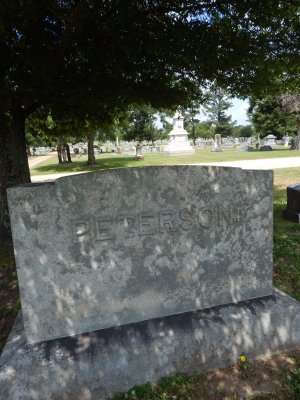
Richard PETERSON ACTIVIST Richard Peterson was born in Dublin Ireland on October 30, 1829. "At age twelve," wrote one biographer, "his father sent him to New York to learn the mercantile business with an uncle who then kept a store on Williams street." When Peterson's situation became "unbearable," he ran away. After living rough on the streets of New York for several months, he drifted west to Ohio, where "he learned the printing business" and "went to school" in the summers. Afterward, he "taught district school winters in Ohio and Pennsylvania," and then studied law. About 1856, Peterson moved to Paris, Texas, where he was "admitted to the bar" and where he would live for most of the rest of his long life. A year later, on July 9, 1857, the twenty-eight-year-old lawyer and land agent married nineteen-year-old Texas-born Susan Clara Fowler, daughter of J. H. Fowler, a Lamar County farmer. The 1860 federal census shows Peterson and his wife living with her widowed father and her brother, John, age nineteen. The census also shows that the young couple had two children, Mary, born 1858, and Samuel, born 1859. During the Civil War, Peterson was appointed Confederate enrolling officer for Lamar County. It is uncertain how long he served. Following the war, Peterson was commissioned a Lt. Colonel in the Third Regiment, Texas State Guard. He also "held the office of County Clerk, County Judge, and District Attorney." In 1867, he began publishing a Republican newspaper, The Texas Vindicator. By doing so, "he attracted the attention of the Ku Klux: and one night about twelve o'clock they surrounded his house to the number of one hundred and fifty disguised men, armed with six-shooters, knives and double-barreled shotguns." Fortunately for Peterson, the hooded terrorists did nothing on this particular occasion other than bully and threaten him before riding away into the night. In 1874, Peterson opened a venue he dubbed "Darwin Hall," obviously named in honor of the English evolutionary scientist Charles Darwin, where "every Sunday" he (Peterson) offered free "Liberal Lectures," by himself "and others," on "scientific, moral, liberal, and theological subjects" to the public. In the spring of that very same year (1874), Peterson attracted perhaps even more attention by publicly debating the noted Christian evangelist Lawrence W. Scott, President of the Indian Territory's Wahpakmucka Institute. In August 1874, Peterson began publishing an eight-page, semi-monthly periodical entitled Common Sense, which was "Devoted to the rise of Reason and the downfall of Faith." Its motto was "One world at a time is enough." In the meantime, Colonel Peterson, as he was generally called, was becoming one of the most commercially successful men in Paris, which the pious citizens of Paris observed with astonishment, and reportedly some bitterness. Calling him "the most inveterate religious skeptic in the whole country," one observer remarked that "notwithstanding the persistent prayers of the 'righteous,'" Peterson was not only "prospering financially" but also was "now erecting a fine brick building on the public square," adding: "It is singular that a man publishing a paper which is disseminating broadcast over the land such skeptical ideas, tending to undermine the very foundation of the Christian structure, should be so favored by fortune; but the ways of Providence are instructable." On August 31, 1877, tragedy struck, not just for Peterson but all of Paris, when a huge fire swept through the city's central business district, destroying everything in its path, including the offices of Common Sense. Clearly, the big fire had an unnerving effect on Peterson. He suddenly moved to St. Louis, Missouri, where on October 1, 1877, the fiery infidel Irishman resumed publication of Common Sense. The paper did not last much longer, however. Its circulation apparently never increasing above 1,000 subscribers, it ceased publication sometime in 1879 or 1880, either just before or after Peterson's return to Paris. During his brief residence in St. Louis (from 1877 to 1880), Peterson joined and served on the Executive Committee of the National Liberal League, headquartered at that time in Boston. During the final decades of the nineteenth century, Peterson apparently took a break from promoting atheism in order to concentrate on making himself one of the wealthiest men in Paris, Texas. Following the 1877 fire he rebuilt the Peterson House Hotel and in 1894, the Peterson Theater was constructed. In 1898, he purchased an Oldsmobile, becoming the first automobile owner in Paris. A few years later he bought a Packard that was reportedly so noisy, the owner of a local country club banned all cars from his property, which at the time affected only Peterson. A short notice in the Fort Worth Daily Gazette for June 4, 1885 that reads "Mr. and Mrs. R. Peterson left for Fort Worth yesterday" but that they planned to "make Paris their future home," indicates that the infidel capitalist and his wife resided in Fort Worth for a brief period during the early 1880s. The following summer, the Petersons vacationed in Europe. They also "spent their summers in the eastern states for many years." In January 1900, Peterson began the new year, the new century, and his return to freethought activism by launching The Examiner, a successor to Common Sense, and then, in February, by taking on Ebenezer L. Dohoney, a prohibitionist, politician, elder of the Christian Church of Paris, and author of Man: His Origin, Nature and Destiny (1885), in a series of debates that were held, apparently, in the infidel publisher's own theater.On June 14, 1904, Peterson's sixty-five-year-old wife, Susan, died and was buried in Paris' Evergreen Cemetery. The following year, perhaps to ameliorate his grief, and despite his own advanced age, Peterson attempted to satisfy his love of travel by setting out on an extended automobile trip with a friend, cotton-buyer E. B. Baker, to Mexico City. However, when they reached Laredo, they were forced to abandon "their prospected trip on account of the rise in Rio Grande and the high waters…in Mexico." The two men returned to Paris by way of San Antonio. On Tuesday, June 11, 1907, at the age of nearly seventy-eight, Peterson no doubt stunned his friends and neighbors (and probably also his middle-aged adult daughter) by marrying a nineteen-year-old Illinois-born stenographer named Stella Pittsford. Curiously, in light of Peterson's atheism, they "were united in marriage at the study of the Cumberland Presbyterian Church in Paris…by Rev. Charles Manton." From all appearances, the marriage did not last long. The 1910 federal census for Lamar County shows Peterson living only with his daughter, Mollie Meehan, at 525 Bonham Street. What became of Stella is a complete mystery. On the eve of his eighty-seventh birthday anniversary, Peterson died in an infirmary at Paris, from injuries sustained when he was struck by an automobile three weeks earlier. His will, which left his entire estate, valued at $75,000, to daughter Mollie and grandson Roy, made no mention of second wife Stella. His final wishes were for no embalming, a coffin costing no more than $25, and no more than $100 to be spent on funeral expenses. It also contained a last diatribe. "I am an Atheist," he wrote (adding in parentheses, "Thank God!") "All religions, Pagan, Catholic, Protestantism, but especially the Christian hoodoo, from A to Z, is a curse-and will be until destroyed off the face of the Earth! Infidels do your duty! I did what I could-at least I did a lot to ward the destruction of the infamy, Christianity!" He was buried at Evergreen cemetery in Paris. |
|
Link to "Find-a-Grave" Memorial |
Richard Potts ACTIVIST For more than 30 years, Richard Potts, the feisty, radical, bespectacled editor of The Common Herd, "the only Freethought publication in Texas," entertained and informed his readers about a whole host of topics including politics, economics, health, current events, but mostly religion, which he eschewed. A former Baptist Sunday School teacher-turned-atheist, Potts took every opportunity to point out the flaws of Christian theology in particular, as well the whole idea of religion in general. He was also a social activist who unsuccessfully ran for public office multiple times, while actively supporting prohibition, women's rights, African-American civil rights, a simplified system of taxation, and free speech. In addition to religion, he also opposed the Ku Klux Klan, repeal of the Eighteenth Amendment, war, and capital punishment. |
Link to "Find-a-Grave" Memorial |
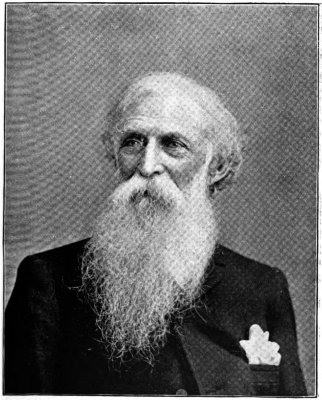
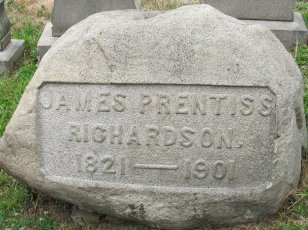
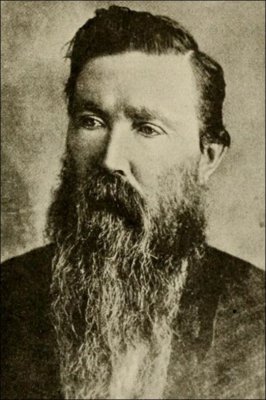
James P. RICHARDSON ACTIVIST From The Truth Seeker, June 8, 1901Death of Judge Richardson. Former Judge J. P. Richardson, a well-known Freethought writer, who at one time was president of the Liberal Association of Texas, died at his home in Austin on May 7. The "sermon" at his funeral was a paper written by himself, which he directed that his executor should read. Judge Richardson was born In Massachusetts, August 20, 1821. He was the son of Puritan parents, and was brought up in all the strictness of that rigid and uncompromising sect. Up to the age of eighteen he accepted the theology that was taught him by his parents, by the New England schools, the Sunday-school, and Jhe church. He was led to read the Bible critically by attending a course of lectures by Father Miller, an honest and pious old man who had devoted himself to the careful study of the Bible, and especially of the prophecies, and had satisfied himself that the world was coming to an end In 1843. The only effect was to stimulate him to careful study of the Bible and the true meaning of the prophecies upon which Miller based his theories. The result was that he lost his reverence for the Bible, and worked out alone and unaided a system of Rationalism. He then began to read Freethought literature, and in 1843 he made the acquaintance of Horace Seaver and J. P. Mendum, and became a subscriber of the Boston Investigator. As he became a Freethinker, he became also an ardent opponent of slavery; and when the civil war broke out he enlisted as a soldier. He raised the first company in all the loyal North for the war. This was in Cambridge, Mass. In January, 1861. At the close of the war he received a commission In the regular army, which took him to Texas. Being offered the position of judge of the seventeenth judicial district, he resigned his commission. In the regular army, and served a term of six years on the bench. During all these years he had always been an outspoken advocate of mental and political freedom. In 1883, when J. D. Shaw established the Independent Pulpit, Judge Richardson recognized the importance of the movement and gave it his hearty support. Although he died in Texas, Richardson was buried at the Cambridge Cemetery in Cambridge, Massachusetts. |
 Link to "Find-a-Grave" Memorial |
Levi James RUSSELL ACTIVIST From Memorial and Biographical History of McLennan, Falls, Bell and Coryell Counties, Texas (Chicago: Lewis Publishing Co., 1893), 558-9: "Dr. L. J. Russell, one of the successful and prosperous men of Bell County, was born February 17, 1831, a son of James Elizabeth (Pierce) Russell. The grandfather of our subject, Anthony Russell, was a surgeon in the Revolutionary war, in the British army. He remained in America after the close of the struggle, settling in Pennsylvania, where the father of our subject was born. They latter afterward went to South Carolina, where he was engaged in mining. He died in Georgia, when our subject was very young, leaving his family no estate. He married Elizabeth Pierce, a native of South Carolina, who afterward moved to Georgia. Mr. and Mrs. Russell had six children, of whom L. J. was the youngest child, and he has only one brother living in Texas, and only three of the family still survive. Dr. L. J. Russell was born in Hall county and reared in Lumpkin county, Georgia, and was educated in the common schools of that State. In 1850 he went to California, where he mined until 1853, during which time he succeeded in making a little money. In 1854 he went to Philadelphia and began the study of medicine, where he graduated in March, 1856, and then returned to Georgia and began practice. In 1858 Dr. Russell removed to Colorado, where he was engaged in mining, and also erected the first house in Denver; next went to Montana; and in 1865 returned to Georgia. While returning from Colorado to that State, by way of New Mexico, Texas, and Arkansas, and while on the Canadian river, he was taken prisoner by the Colorado Cavalry, under Lieutenant Shipe, was carried to Fort Union, and there imprisoned. He was afterward released by his friend, Marshall Hunt, of Colorado. He was relieved of all his money and other property, but Mr. Hunt, who was afterward Governor of Colorado, succeeded in restoring his possessions. Dr. Russell afterward returned to Colorado and later went to Montana. While on the road to Montana, he was shot in two places with arrows by the Indians, one in the hip and the other in the breast, both server but not fatal. In 1865 he went again to Georgia and resumed the practice of his profession, and in 1868 came to Texas, settling in Bell county. He bought a small tract of land, erected commodious buildings, and has made a great success as a practicing physician. Dr. Russell married Miss Mary Roe, a daughter of Thomas Roe, a blacksmith and gunsmith by trade, who removed from South Carolina to Georgia. Dr. and Mrs. Russell have had nine children, viz.: Charles V., deceased at the age of one and half years; Thomas, who died at the age of nineteen years; Maud, wife of O. Bean, a farmer of Bell county; Skylark, a music teacher by profession; Gail and Linnett, at home; Echo, who died at one year of age; and Jim Dick and Rob Jack, at home. Dr. Russell, was a member of the Masonic order, and Master of his lodge, but was expelled for heresy. He also withdrew from the Knights of Pythias. He makes no claims on religion, and is a Democrat in his political views." In 1877, Dr. Russell came to national attention when on October 6 of that year, he was lured by false pretenses into a remoted area by a group of Baptists, who horsewhipped him for being an "Infidel." The incident was widely reported in both the mainstream and freethought press. In addition to being President of the Bell County Freethinkers, Russell served on the Executive Committee of the National Liberal League. |
Link to "Find-a-Grave" Memorial |
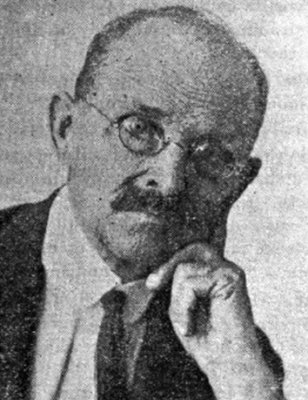
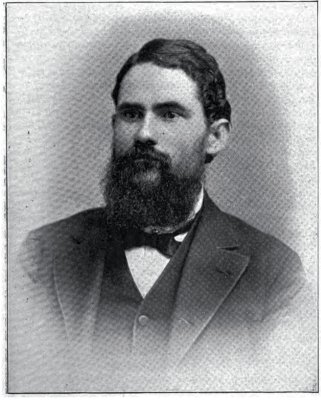
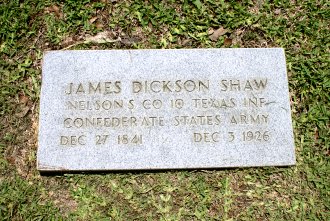
James Dickson SHAW, ACTIVIST, was born on December 27, 1841 in Walker County, Texas. During the Civil War, he served as a Second Lieutenant in the 10th Texas Infantry, C.S.A. After the war, he was an active member of the Pat Cleburne Camp, U.C.V. In 1870, Shaw became an ordained Methodist minister. In 1878, he moved to Waco, where he served as pastor of the Fifth Street Methodist Church until 1882, when, after preaching a sermon that stressed good works over faith, Shaw was called before a church examining committee in Cleburne. After he admitted his unorthodox opinions, the committee stripped him of his credentials. Later that same year, Shaw founded the Religious and Benevolent Association and in 1883, he began publishing a monthly newspaper titled The Independent Pulpit, the masthead of which stated that its purpose was "to serve as a forum for the most liberal and independent thinkers on the moral, social, and intellectual questions of the day." In 1890 Shaw organized the first meeting of the short-lived Texas Liberal Association in Waco, where he was elected president. He later served as secretary. The group disbanded following the 1894 convention in Temple. During his heyday, Shaw was a sought-after public speaker who frequently traveled around the state to address his fellow freethinkers. In Waco, he served for a time on the city council. Following the death of Iconoclast publisher W. C. Brann in a gunfight with an offended Baptist, Shaw wrote a biography of his old friend. In 1881, Shaw's first wife, Lucy, died, leaving him with six children to raise alone. In 1884, he married Rachella Dodson, who died in Waco in 1902. In 1900 Shaw suspended publication of The Independent Pulpit, replacing it in 1901 with The Searchlight, which he edited until 1910, when he moved to Glendale, California, where he lived with two of his daughters and a grandchild. He died in California on December 3, 1926. He was later buried at Waco's Oakwood Cemetery. Even Shaw's theological opponents respected him. One Baptist minister, J. B. Cranfill, wrote that "while his arguments were clearcut and emphatic, he never at any time ceased to exemplify the high qualities of good breeding and gentlemaness." |
|
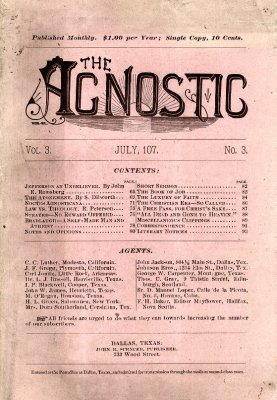
John R. SPENCER, ACTIVIST, printer and publisher of The Agnostic, was born in Ohio in 1846. At some point in his early life, he moved to Texas, where on December 13, 1875, in Houston, he married Ida Genevieve Smith, born 1852. In 1879, while living and working in Dallas, Spencer began publishing The Agnostic, which was "devoted to the rise of Reason and the downfall of Superstition." Ironically, he had previously worked as a printing room foreman at the offices of The Texas Baptist, also located in Dallas, which may explain why he started publishing a freethought periodical! One cannot help but wonder what Spencer's former employers thought about his new venture, although it is not too hard to imagine that they disapproved. In its fifth and apparently final year, 1884, The Agnostic purportedly had a circulation of 1,000. During this time, Spencer and his family resided on Wood Street, where the family's home doubled as a print shop and office. There is no record of why The Agnostic went out of business. While it is possible that the journal was the victim of social pressure, chances are it was simply unprofitable due to an almost certainly limited readership. Unfortunately, there seems to be only a few extant copies. Sometime in the mid-1880s, Spencer and his family moved to McLennan County, where his wife, Ida, died on March 4, 1888. She is buried at the Crawford Cemetery in Crawford, Texas. Spencer was not only an "infidel" but also a union man. In May 1923 a writer for the Dallas Morning News observed that he was "one of the oldest printers in the state," and announced that as a "veteran member of Waco Typographical Union No. 188," he would be attending "the annual meeting of the Allied Trades Council at Dallas." A few years later, an aging Spencer was admitted to the Union Printers Home in Colorado Springs, Colorado, where he died on November 7, 1934 at the age of eighty-eight and was afterward buried in Evergreen Cemetery -- a peaceful, shady burial ground that offers the living a magnificent view of Pike's Peak. |
|
Ross Winn, ACTIVIST, printer and publisher of multiple freethought and anarchist publications, was born in Denton County, Texas on August 25, 1871. He died at Mt. Juliet, Wilson County, Tennessee on August 8, 1912, just a few days short of his 42nd birthday. His parents were John F. and Isabella "Bell" Winn, natives of Alabama and Mississippi, respectively. Winn shared much in common with the slightly older and better-known Chicago anarchist, Albert Parsons, who was hanged in 1887. Both were raised in Texas, both were typesetters by trade, and both were radical journalists whose impassioned writing was printed in their own and other publications. In Winn's case, journals such as The Firebrand and Emma Goldman's Mother Earth. Winn also an outspoken Atheist. When he was in his twenties, he was a member of the Dallas Freethinkers society, where his occasional presentations at meetings of the group were either about anarchy or atheism. In 1891, Winn and his parents moved to Dallas County, where in 1894, Winn's earliest published writing appeared in a magazine or newspaper called Twentieth Century. The piece, entitled "Let Us Unite," was political in tone. In 1895, in Dallas, Winn started the "People's Church," a "non-creedal and non-section" organization for the purpose of discussing "current problems." In 1896, a presidential election year, he was active in the Populist movement. Just as the year was coming to an end, along with two partners, he incorporated the Industrial Publishing Company of Dallas, with capital stock of $30,000. The following year, at a mass-meeting held at the Dallas city hall, he was elected to a committee charged with drafting resolutions in favor of striking mine-workers in Pennsylvania. During his sojourn in Dallas County, Winn published, in succession, three journals: Co-operative Commonwealth, the Coming Era, and Winn's Freelance, using a printing press that he purchased with money that he had earned picking cotton. None of these magazines or newspapers were successful financially. After Winn married Augusta Smith in 1899, he moved to Mt. Juliet, Tennessee, where his wife was from and where the couple had their only child, Ross Winn, Jr. In 1901, during a trip to Chicago, Winn met and began a friendship with Emma Goldman, who was then one of the most celebrated and reviled (depending upon point-of-view) anarchists in America. Sometime between their move from Denton County to Dallas County in 1891 and 1901, both of Winn's parents died, first his father and then his mother. There was no mention of their deaths in local papers nor is it known where they were buried. It is known, however, that Ross Winn's sister, Mary Winn Benedict, along with her husband, Robert, filed a lawsuit in a Dallas County court in 1901, asking for partition of their parents' property. By this time, Ross was living in Tennessee. On July 30, 1901, because the property was so small, the court ordered that it be sold at auction, which it was, for $25, and the proceeds evenly divided between the two siblings, each one receiving $12.50 for a tract of land that had previously been valued at $150. For some unknown reason, a farmer named Wiley W. Thrift was also named in the suit, as being in possession of the property. From all appearances, Ross Winn either rented or leased his parents' property to Thrift, or simply allowed him to live there, after he (Winn) moved to Tennessee. In Tennessee, Winn and his wife and son lived with her parents, in a house that dated back to the 1790s. His father-in-law, who died in 1901, operated a general store and a mill. From all accounts, Winn had an uneasy relationship with his in-laws, almost certainly because of his radical politics (and perhaps his atheism too), and possibly also because he earned so little from his publications, first Free Society (begun in 1902), and then Winn's Firebrand, that he was unable to provide for his family without their help. In 1905, Winn and his little family moved to Nashville, where he briefly published a newspaper or magazine called To-Day. It wasn't long, however, before they returned to Mt. Juliet. In 1910, for some reason that has been lost to history, the Winn family moved again, this time to Sweden, Texas, a tiny town in Duval County, about 150 miles south of San Antonio, to which Winn traveled in search of work. Sweden is now a ghost town. In 1911, the Winns returned to Mt. Juliet, after Winn was forced by circumstances to sell his printing press. The following year, after Winn died of the tuberculosis that he contracted in 1909, fellow anarchist Emma Goldman wrote:
For another look at Winn's Life, see Ross Winn: Digging Up a Tennessee Anarchist. |

|
Link to "Find-a-Grave" Memorial |
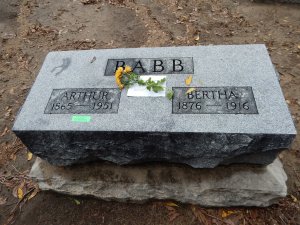
Arthur BABB NOTABLE Born in a rustic log cabin at Fairfield, Texas on October 31, 1865, Arthur Babb grew up in a succession of rural communities where his total time in school came to less than one year. Yet despite this educational handicap, Arthur managed to transcend his humble beginnings. Starting out as a farmer, he went on to work as a railroad carpenter, architect, building contractor, and finally, during his old age, a bookbinder. Endowed with natural intelligence and inquisitiveness, Arthur also managed to acquire knowledge and make up for his lack of formal schooling by becoming a voracious reader of books, magazines, and newspapers. His seemingly inherent ability to think critically about what he read—to investigate, analyze, and draw conclusions, served him well and by the time he reached his sixties he had become a freethinking agnostic. His favorite subjects were history, biography, science, and religion. In his old age, Arthur wrote a series of essays, critical of religion, which were apparently for his own amusement. In 2015, these were published by the Freethought Press of Texas under the title A Biblical Merry-Go-Round. Suffering from various infirmities, Babb took his own life in 1951, just a few days short of his 86th birthday. He is buried at Myrtle Cemetery in Ennis, Ellis County, Texas, next to his wife, Bertha, who predeceased him. |
|
Link to "Find-a-Grave" Memorial |
Ovee (Ove) Torgerson Colwick (Kjølvig) NOTABLE Ovee Torgerson Kjolvig Colwick was born on March 25, 1825 at Stavanger, Rogaland, Norway. He died at Clifton, Bosque County, Texas on July 12, 1895. In 1853, at Stavanger, Colwick married Johanne Margarett Johannesdatter Naadland. In 1854, the newly-weds immigrated to America, where they initially lived in Illinois. Just prior to the Civil War, upon the recommendation of Kleng (or Cleng) Peerson, said to be the father of Norwegian immigration to America, they removed to Texas, where they settled in Bosque County, on 160 acres given to them by Peerson, on condition they provide him with a home and care for him in his old age. During the Civil War, Colwick served in the Confederate Army. Only a few months after the war was over, Peerson died. It appears that Peerson, a former Quaker, influenced Colwick to abandon religion. According to one informant, Peerson was "the most pronounced freethinker I have ever known...He believed little or nothing of the Bible, especially the supernatural part thereof." Here is an obituary notice written by Colwick's sons. It appeared on page 602 of the October 1895 issue of Free Thought Magazine (to which Colwick subscribed), following their father's death:
|
|
Link to "Find-a-Grave" Memorial |
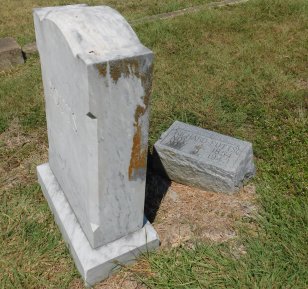
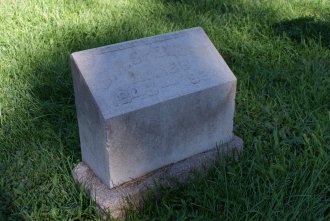
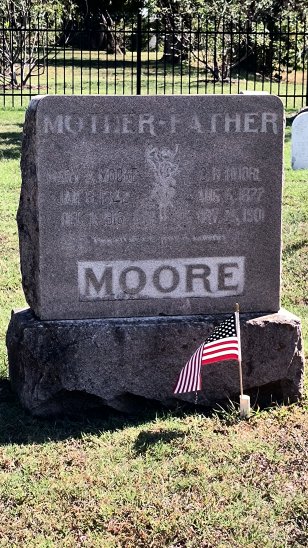
Charles Bingley Moore NOTABLE Charles Bingly Moore, a well-known "infidel" of Collin County, Texas, was born in 1822 in Tennessee. He served in the U.S.-Mexican War. He was a distant relative of Charles Chilton Moore, editor of The Blue Grass Blade, an "infidel" newspaper, published in Lexington, Kentucky. He was a millwright, farmer and mechanic in Tennessee, Illinois and Texas, who at the time of his death had been an "infidel" or unbeliever for fifty years. He came to Texas in 1856 and bought the land on which he lived and died. Moore died peacefully on his farm near Chambersville, Collin County, Texas at the age of 79. He was buried in the famiy cemetery. Although Moore was not known to have been a member of any freethought society, nor to have written anything about freethought for publication, nor to have lectured about "infidelity," in his will, he left instructions for a non-religious funeral and a statement and epitaph that summed up his philosophy of life and death, writing:
|
Link to "Find-a-Grave" Memorial |
Henry C. RENFRO NOTABLE Henry Carty Renfro, was born near Maryville, Blount County, Tennessee, on July 18, 1831. In 1851, following a brief sojourn in Georgia, his family moved to Cass County, Texas. Renfro studied to become a minister at Baylor University, where he was taught by university president Rufus C. Burleson and George W. Baines. In 1857, while still a student, Renfro briefly became the pastor of the Independence Baptist Church. After moving to Johnson County, he conducted revivals and helped establish the Bethesda Baptist Church. In 1859 Renfro married Mary Robinson Ray, a fellow Tennessee native, with whom he had a son in 1860. During the Civil War, Renfro served in Company C of William H. Griffin's Twenty-first Texas Infantry Battalion. For a while, he served as chaplain of the Fifteenth Texas Infantry. During the war, Renfro took part in the battles of Bayou Bourbeau, Vidalia, Mansfield, Pleasant Hill, and Yellow Bayou. In 1864, he fathered a daughter. After the war, Renfro served as the minister of several Baptist congregations in Johnson and Tarrant counties while also farming and trading in land. He established the town of Burleson, named for his former professor. For a time, Renfro was highly regarded as a Baptist minister, but when he started to openl question Baptist orthodoxy, he was charged with "advocating and preaching the doctrine of infidelity." In 1884, this resulted in his dismissal from the ministry and the Baptist Church. Thereafter, he lectured about freethought throughout North Central Texas. Unfortunately, his freethought activities were brief. He died on March 2, 1885, slightly more than a year later, from pneumonia. His son, Burleson, died three days later. Following Renfro's death, Baptist publications reported that he recanted his "infidelity," which was denied by both family and friends. Nevertheless, Rufus Burleson preached Renfro's funeral service, and he (Renfro) was buried in the Bethesda Baptist Church cemetery, in Johnson County. The Victorian-style house built by Renfro's widow and daughter, in 1894, is still standing today, at 128 N. Clark Street in Burleson. A Texas State Historical Association marker is on site. |
Link to "Find-a-Grave" Memorial |
Ike Towell NOTABLE Isaac "Ike" Towell was born on November 25, 1849 (or 1850) in Tennessee. He died, by suicide, on February 22, 1934, at the age of 83 (or 84) in Columbus, Texas. Although Towell was a lifelong "infidel," and known to be so by his neighbors in Columbus, Colorado County, Texas, and also Bay City, Matagorda County, Texas, where he lived for a time before returning to Columbus, he was not an active member of any freethought organization, not did he write or lecture on the topic (so far as it is known). Interestingly, it was in death that Towell became famed, when newspapers across the United States, and as far away as California and New York, carried the story of his suicide, which came as a result of chronic ill health. In section eight of his will, which he directed be read at his graveside, he wrote: "My religion consists of doing right and loving justice. I affirm that all men should tell the truth and pay their debts. I do not believe in any God, devil, ghost or savior, and I have opposed tobacco, whiskey, gambling, lying and stealing practically all my life. If any one of the clergy ever calls my name after death I insist that he speak the truth about me, a thing I have never known a preacher to do about a dead disbeliever. The clergy have never been able to bribe me with the promise of a beautiful home and a fictitious heaven nor bluff me by their everlasting punishment in a hell of fire and brimstone." On his tombstone Towell directed that the following inscription be engraved: Here rests Ike Towell |
|
Established October 31, 2015 Copyright © 2015-2024 The Freethought Press of Texas. All rights reserved. |